
The legal trap we live in
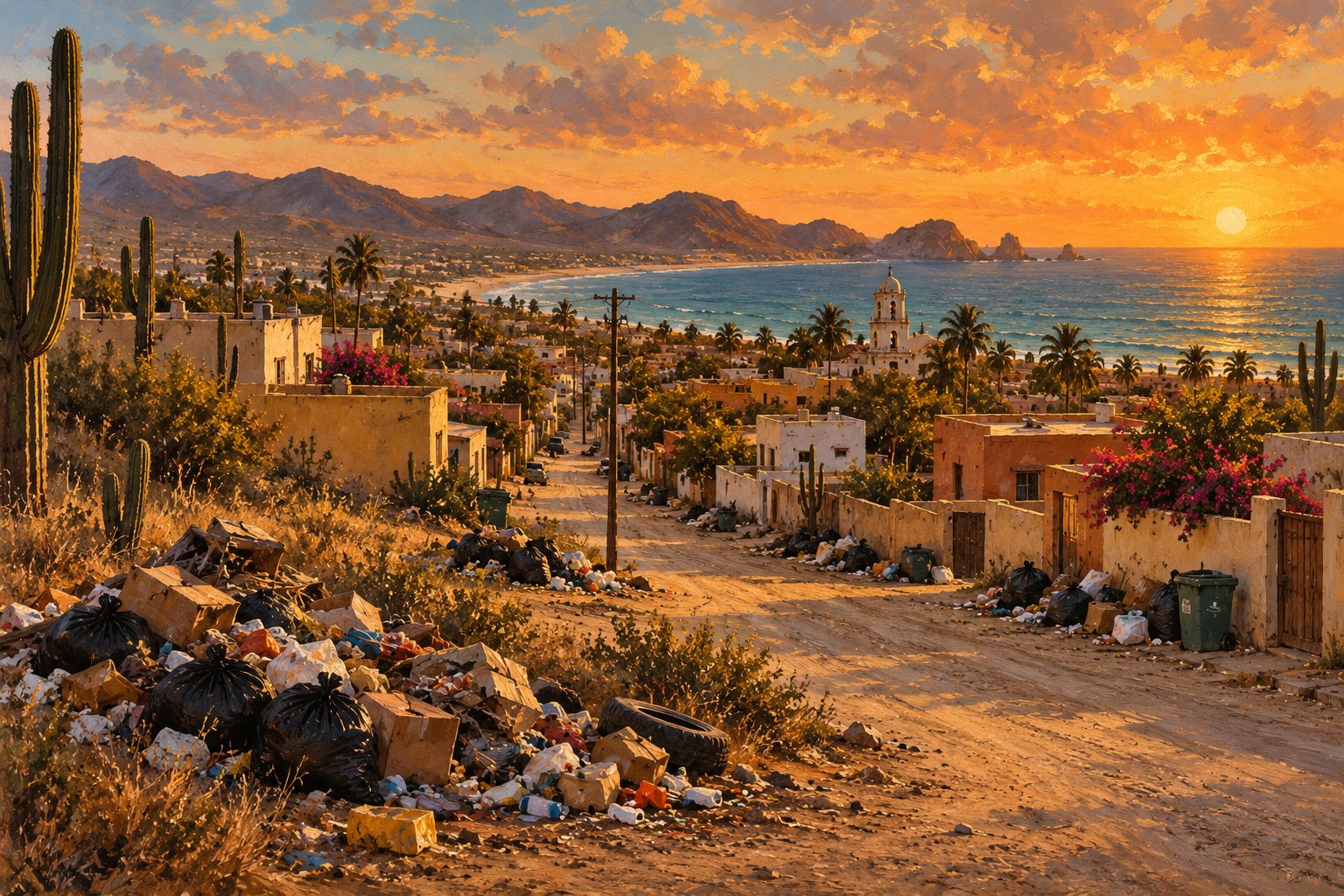
Next time you drive through town, look closely. Vacant lots full of torn bags. Trash piled against walls. Arroyos that turned into dumps. We've normalized it.
It shouldn't be this way. And what most people don't know is that the law prohibits it, in two directions.
Article 61 requires residents to prevent the accumulation of trash and waste on vacant lots they own or occupy, and gives the municipality a concrete procedure: order the offender to clean up within no more than three calendar days, and if they don't, carry out the cleanup at the offender's expense. Article 13 requires vacant lots to be fenced and kept free of contaminants, weeds and trash. Article 67 strictly prohibits dumping trash in the open, in streambeds, arroyos, ravines and public roads, and also prohibits burning any kind of waste.
The municipality has full legal authority to fine residents who let trash accumulate on their property. It also has a legal obligation to send trucks to collect it. Article 16 says so plainly:
"Outside the primer cuadro of the city of La Paz, and in the other communities of the Ayuntamiento, collection of garbage and waste shall be carried out twice a week, between 6:30 and 14:30 in winter, and between 6:00 and 14:00 in summer."
Twice a week. For the whole community, not part of it.
What actually happens
This is where precision matters, because this story is easy to tell wrong, and telling it wrong does a favor to whoever doesn't want it fixed.
It is not true that the truck never comes to Todos Santos. It comes. The problem is how unevenly it comes, and that nobody can explain by what criteria.
- Downtown Todos Santos: three times a week. Above the legal minimum.
- Colonias like San Vicente: once a week. Half of what the regulation requires.
- Several outlying colonias: nothing at all.
If you live downtown, you may well read this and think we're exaggerating. And you'd be right, about your street. That is exactly the point. The service exists, works well for a few blocks, drops to half a few meters further out, and disappears entirely before it reaches the edges. All within the same community, under the same rule, which says twice a week for everyone.
The map nobody has been able to show us
That same Article 16 ends with an obligation almost nobody knows about, and it's the most important part of this whole business:
"To comply with the collection procedure set out in this article, the Ayuntamiento shall divide the city of La Paz and the other communities of the municipality into zones and routes and shall publish that division, along with the days on which collection will operate."
Shall divide. Shall publish. It does not say "may." It's an obligation, and it has been in writing since 1995.
We went looking. Here is what we found, and what we didn't.
What does exist. The Ayuntamiento has a public page, lapaz.gob.mx/camiones-de-basura, titled "Recolección de Basura / Ruta Cero." It's a map, and it says, in these words: "The marked areas indicate where garbage collection will take place today." It's a map of the day, centered on the city of La Paz. There's also the App La Paz, which shows the trucks' location in real time. And almost daily the Ayuntamiento publishes bulletins listing which colonias of the city the truck reached or will reach.
What we didn't find. None of that is what Article 16 asks for. A map of today is not a division into zones and routes with the days collection operates. Neither is live tracking. Nor is yesterday's list.
We looked on the municipal website, in its bulletins, in the transparency portal, in the state's Boletín Oficial, and in the press. We asked at the delegación. We did not turn up a published division of zones, routes and days for the municipality, let alone one that includes Todos Santos or El Pescadero. In the municipal bulletins, every time routes come up, it's "colonias of the city."
If it exists, show us. We'll publish it here the same day, gladly. It would be the best news in this article, because it would finally give us something to measure against.
Until then, without that document nobody can claim anything. A neighbor the truck never visits has no way to prove they were owed a pickup, and the authority has no way to prove they weren't.
One detail makes it more absurd still. Article 21 requires residents to put their trash out "only on the days established for that purpose." We're held to a calendar we were never given.
This is not the delegación's fault
This needs saying, and saying first.
The Todos Santos delegación operates with very few collection vehicles. They break down often. When they have to be sent to La Paz for repair, they take a long time coming back, and someone has to keep pushing to get them returned. With what they have, they do what they can.
The right question isn't why the truck didn't come this week. It's why a community this size, generating what it generates, operates with the equipment it operates with. And that decision isn't made here.
What La Paz has, with our money
The city of La Paz runs 25 collection trucks on 44 daily routes, covering more than 260,000 people in over 101,000 homes, with 98% efficiency reported in September 2025.1
Look at the word routes. Over there the service is organized: the city is divided up, each colonia has its route and its days, and residents know when their turn comes. That is exactly what the last paragraph of Article 16 orders, and exactly what doesn't exist here.
We're not saying every house in La Paz gets the truck on the same day. We're saying they have a route system with assigned days, and we don't — or if we do, it was never published.
That service is funded by the municipal budget, a budget fed by the taxes we generate here: property tax on every house, construction permits, and the commercial and tourism activity of the whole region.
And since January, we pay something more
On January 1, 2026, the Environmental Sanitation Levy took effect across the municipality. Every hotel night and every night in a house rented through a platform in our region pays it.5
Where that money goes is written into law, in Article 148-E of the Ley de Hacienda del Municipio de La Paz. Among other things, it includes, in these words: "the integral treatment of urban solid waste."
That money pools into a municipal trust. And the law does not set aside a single peso for the community where it was collected.
What we do instead
Without adequate collection, neighbors cope however they can. Some burn, even though Article 67 prohibits it. Others bury. Many let it accumulate, which exposes them to the fine under Article 61.
And those of us in the north end of town and the colonias furthest from the center do something else: we drive our trash to a meeting point, hand it to the crew, and pay.
Here it's worth being exact, because the detail changes everything. That truck does belong to the Ayuntamiento. It isn't a private operator filling a gap. It's a municipal truck, with municipal workers, that covers the route it's assigned and for the rest of us stops at a gathering point. We haul our trash there and pay around 200 pesos to have it taken.
So: we pay taxes for a service, we drive to the handover point to reach it, and we pay again in cash when we get there.
We don't know whether that charge has any basis. Article 8 of this same regulation says the Ayuntamiento "reserves the right to institute charges" for the services it provides, which means any charge has to be established somewhere. We haven't seen where this one is established, and we've never been given a receipt. It's an open question and it's worth asking out loud.
And even so, if you have trash accumulating on your lot, the same municipality that never finished the route can send you a fine.
It's not just an image problem
Public health. Uncollected waste breeds pests, accelerates dengue, and contaminates soil and groundwater. BCS generates 649,271 tons of waste per year, and more than 90% of final disposal sites in the state fail to meet environmental standards.2 Open burning releases dioxins and heavy metals into the air we breathe.
Property value. Todos Santos sells itself as a magical, authentic, sustainable destination. That promise breaks every time a tourist or prospective buyer comes across informal dumps along the road.
Identity. We're a Pueblo Mágico. Tourism is our economy. Image matters, but so does the actual health of the place we live.
We're not the first to solve this
Tulum built Puntos Limpios, community recycling centers by colonia. Result: more than 279 tons of recyclable material recovered per year in a first phase.3 A coalition of 56 resorts is already committed to zero waste by 2027.
Sayulita launched Operation Trash to modernize its infrastructure as a Pueblo Mágico. Their argument: if we're a serious destination, we have to be one.
Here in Todos Santos, Alianza Cero Basura already diverts 60% of the town's organic waste to composting.4 The will and the knowledge are already here. What's missing is the municipal structure to sustain them.
From problem to resource
BCS generates 649,271 tons of waste a year. 46% is organic. 32% is recyclable. 78% of what we throw away could be put to use.2
Community composting. Organic waste becomes fertilizer for local agriculture. Alianza Cero Basura already does this. With institutional support it scales.
Recycling centers. Paper, plastic, glass and metal separated at the source. They have market value and can finance part of the system.
Biodigesters. Organics that don't go to compost generate biogas for community kitchens or public lighting.
Local economy. Upcycling workshops, crafts from recovered materials, premium compost for organic agriculture.
Conscious tourism. Being Mexico's first zero-waste tourist destination isn't just an environmental achievement. It's a real market advantage.
Why it all leads to the same place
La Paz has 25 trucks because it has the budget. It has the budget because it directly administers its own municipal revenue. We generate tourism, property tax and construction permits, and since January the Environmental Sanitation Levy as well. All of it goes there.
This isn't about anyone in La Paz being a villain. It's that the system is built so decisions about our trucks, our routes and our budget get made two hours away, by people who don't live with the result.
Our own municipality for Todos Santos and Pescadero isn't a romantic idea. It's the difference between depending on someone in La Paz deciding to attend to us, and having the structure to attend to ourselves. With our own budget, we contract the trucks, set the routes, publish the map, build the collection centers, and design the system this community deserves.
What you can do today
Help us build the map the municipality never published. Reply with two things: your colonia, and how often the truck comes and on what day. With that we'll build the real collection map of Todos Santos and publish it. And if it turns out the service is better than we thought, we'll say that too.
Also:
- Support Alianza Cero Basura / Cero Basura BCS with time or a donation.
- Separate waste at home: organics, recyclables, the rest.
- Use refill stations instead of plastic bottles.
- Ask your business to eliminate styrofoam and single-use plastic.
- Support the effort to create our own municipality, so that we are the ones deciding this region's future and not someone else.
1 BCS Noticias, September 2025. Statements from the municipal presidency.
2 Diagnóstico de Generación de Residuos Sólidos para Baja California Sur, Ponguinguiola / SEPUIMM, April 2025.
3 FEMSA Foundation, December 2020. Puntos Limpios Program, Tulum Sostenible Cooperativa.
4 Todos Santos Eco Adventures / TOSEA, Our Impact, 2024.
5 Decreto 3263, Boletín Oficial del Gobierno del Estado de BCS no. 88, December 24, 2025. Adds articles 148-A through 148-H to the Ley de Hacienda para el Municipio de La Paz. In force since January 1, 2026.
Legal framework: Reglamento de Aseo, Limpia, Desechos Peligrosos y Potencialmente Peligrosos del Municipio de La Paz, BCS. Published in Boletín Oficial No. 36, October 10, 1995. Last reform: Boletín Oficial No. 25, July 10, 2017. Arts. 13, 16, 21, 61, 67. Article quotations translated from the Spanish original.