
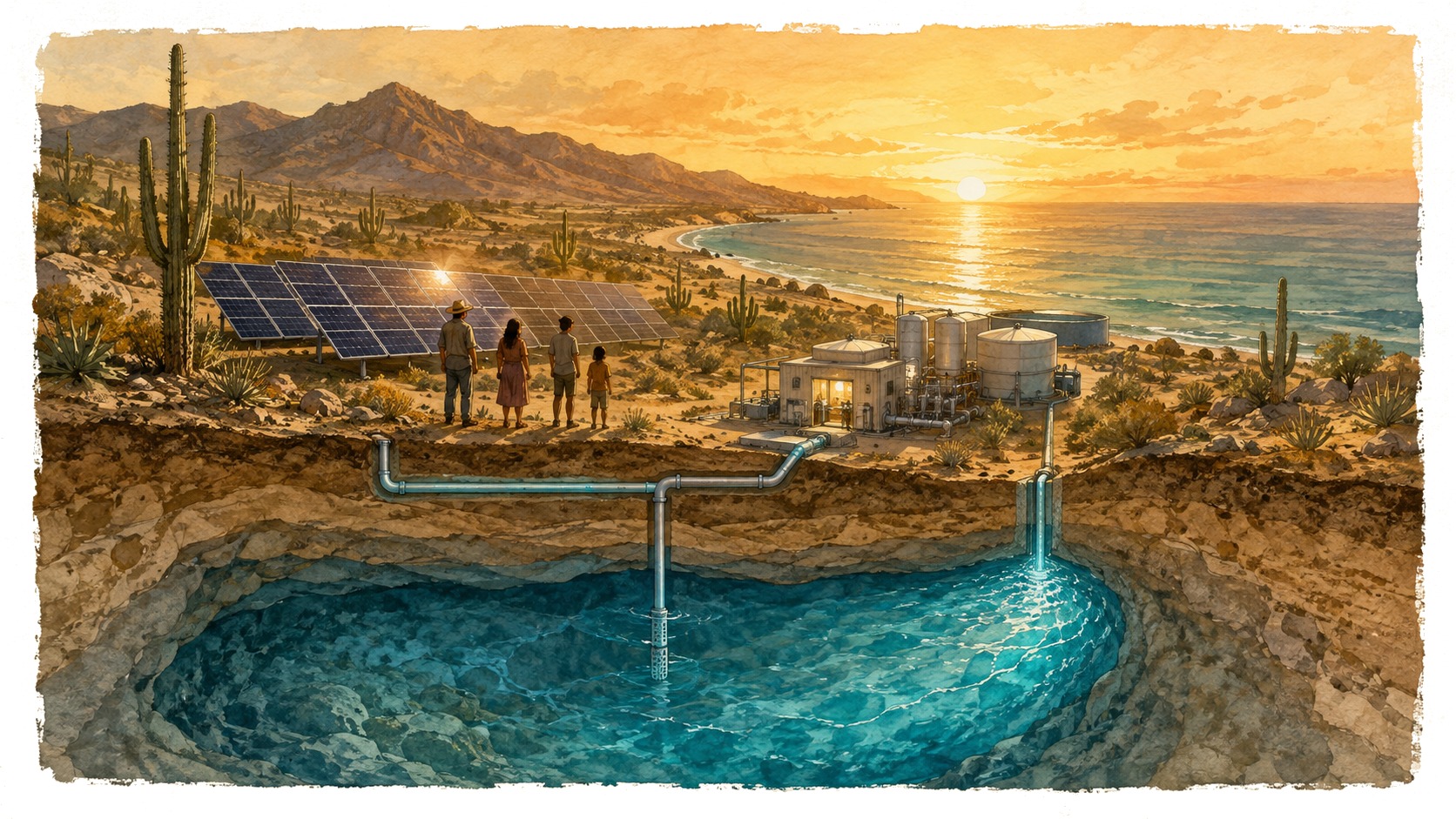
Here's a fact that should make every person in Baja California Sur stop and think: we live in a state with some of the most abundant sunshine on the planet, and we also pay some of the highest electricity rates in all of Mexico.
That's not just frustrating. It's the key to everything we've been talking about in this series.
In our first article, we explored how desalination works and what it costs. In our second, we laid out a path to actually recharge our depleted aquifer. Both articles kept landing on the same bottleneck: energy. The desalination plant runs on electricity. The pumps run on electricity. The aerators, the monitoring equipment, the injection wells — all of it. Electricity is the single biggest operating cost in every water solution we've discussed.
So when we started asking "how do we make these solutions affordable for an entire community?" the answer was staring us in the face. Literally. Every single day. For about 300 days a year.
The BCS energy paradox
Baja California Sur is the only state in Mexico whose electrical grid is completely disconnected from the rest of the country. While every other state in Mexico draws from the National Interconnected System, our electricity comes from a local grid powered primarily by imported fuel oil, one of the dirtiest and most expensive fossil fuels there is.
Electricity rates in BCS can reach over 6 pesos per kilowatt-hour during summer, roughly three times the national average. Businesses on the commercial PDBT tariff pay even more. And if a household's consumption crosses CFE's threshold into the DAC rate, the price jumps dramatically with no subsidy cushion.
Then there are the blackouts. BCS's isolated grid is vulnerable during summer peak demand, during hurricanes, and during any period when aging infrastructure can't keep up with a rapidly growing population. In 2026, demand for solar installations hit historic levels across the state. Not because people suddenly became environmentalists. Because they got tired of losing power and paying for the privilege.
As one local solar company put it: BCS has some of the best sun in the world and some of the worst power situations.
What does this have to do with water?
Everything.
Go back to the numbers from our first article. The desalination plant we visited pays 70,000 to 80,000 pesos per month in electricity to CFE, running both the desalination system and the wastewater treatment plant. That's roughly 900,000 pesos a year. And that's for a relatively small operation producing about 16,800 cubic meters of freshwater annually.
Now scale that up to the community-level recharge system we described in our second article — a plant producing 870,000 cubic meters of freshwater per year for aquifer injection. Without solar, the annual operating cost would be 20 to 25 million pesos. The vast majority of that is electricity.
With solar panels powering the operation, that drops to 7 to 10 million pesos per year.
That difference — 13 to 15 million pesos annually — is not a small number. Over the life of the system, it's the difference between a project that's financially sustainable and one that bleeds money.
And here's what makes it even more compelling: the solar installation that creates those savings pays for itself within a few years. After that, the energy is essentially free for the next 20 to 25 years. The panels keep producing. The sun keeps showing up. The operating cost stays low.
The math on solar-powered water
In our first article, we calculated that desalinated water at the plant we visited costs about 54 pesos per cubic meter on electricity alone. Including the full capital investment amortized over 15 years, it comes to roughly 73 to 99 pesos per cubic meter depending on how much of the plant's capacity is being used.
Water from a truck costs 140 pesos per cubic meter.
Now add solar. If you eliminate the electricity cost — which dominates the operating budget — the fully loaded cost of desalinated water drops to roughly 35 pesos per cubic meter. That's 75% cheaper than truck water. Not marginally cheaper. Fundamentally cheaper.
For a household spending 2,500 pesos every time a water truck fills their cistern, that math matters. For a hotel spending hundreds of thousands a year on electricity, it matters even more. And for a community trying to fund an aquifer recharge program that could secure its water supply for generations, it's the difference between feasible and fantasy.
Why BCS is uniquely positioned
Most conversations about solar focus on the environmental benefits. And those are real. But in BCS, the economic argument is so strong that the environmental angle is almost beside the point.
Three things make our region different from almost anywhere else:
The electricity is extremely expensive
BCS rates are among the highest in Mexico because of the isolated grid and imported fuel oil. That means every kilowatt-hour replaced by solar saves more money here than it would almost anywhere else in the country. The payback period for solar installations in BCS is shorter than the national average, sometimes dramatically so. Commercial solar systems in similar conditions can pay for themselves in under two years.
The sun is abundant and reliable
BCS receives approximately 300 days of sunshine per year with an average of 6 peak sun hours daily. That's among the highest solar irradiance levels in the world. The resource isn't seasonal or intermittent the way it is in cloudier regions. It's consistent, predictable, and massive.
The grid is unreliable
This isn't just about saving money. It's about having power when you need it. Every summer brings blackouts. Every hurricane season brings outages. Solar with battery storage provides energy independence — the ability to keep running when CFE can't deliver. For a desalination or recharge system that needs to operate continuously, grid reliability isn't a nice-to-have. It's essential.
Put those three together and you get a situation where solar isn't a luxury or a statement. It's the most practical, most economical choice available.
What solar-powered water infrastructure looks like
This isn't theoretical. The components exist, they're proven, and they're already being installed across BCS.
For the desalination plant we visited in Article 1, adding solar would mean a panel installation sized to match the plant's electricity demand — roughly 50 to 100 kilowatts depending on usage patterns — with battery storage to maintain operations during nighttime hours. Cost: approximately 1 to 3 million pesos. The electricity savings at BCS rates would pay that back in 2 to 4 years.
For the community-scale recharge plant described in Article 2, the solar installation would be larger: roughly 1 to 1.5 megawatts. That requires about 2 to 3 hectares of land, which in a region with thousands of hectares of open desert is not a constraint. Cost: approximately 20 to 40 million pesos for the solar component. But the annual savings of 13 to 15 million pesos mean the installation pays for itself in about 3 years.
After that, the community recharge plant operates on nearly free energy for the remaining 20+ years of the panels' life. Over a 25-year period, solar saves the project somewhere between 250 and 375 million pesos in electricity costs. That's roughly equal to the entire capital investment of building the plant in the first place.
Solar doesn't just reduce the operating cost. It effectively pays for the construction.
Beyond water
Once the solar infrastructure exists for the water systems, it opens doors that go beyond water.
A municipality with its own solar generation capacity could power municipal buildings, street lighting, and public services at a fraction of current CFE costs. Schools, clinics, and community centers could run on locally generated clean energy. The savings from reduced electricity bills could fund other priorities, from road maintenance to public safety.
Right now, our community depends entirely on an isolated, aging, fossil-fuel-powered grid managed from outside our region. Every time CFE can't keep up, we lose power. Every time fuel prices spike, our bills go up. We have no control over any of it.
Solar generation, owned and managed locally, changes that equation. It's the energy equivalent of what desalination does for water: instead of depending on a distant, unreliable system, you build your own.
Water independence. Energy independence. The pattern is the same.
How this connects to everything
Article 1 showed that desalination works and is already cheaper than truck water. But electricity is the dominant cost.
Article 2 showed that we can actively heal our aquifer through managed recharge, with a community-scale system costing 140 to 240 million pesos. But the operating budget depends heavily on electricity.
This article shows that solar eliminates that dependency. It makes desalinated water 75% cheaper than truck water. It cuts the recharge plant's operating cost by more than half. And the solar installation pays for itself within a few years, then produces free energy for decades.
The ocean gives us water through desalination. The sun gives us the energy to make that affordable. And managed recharge gives us a way to heal what we've already damaged. Each one works on its own. Together, they're a complete system.
What's next
There's one more piece to this puzzle, and it's the one that connects everything to action.
In our next and final article in this series, we'll bring together everything we've covered and lay out what a real plan looks like for our community: the water solutions, the energy infrastructure, the costs, the timeline, and the critical question — who has the authority and the resources to make it happen?
We'll also explore an idea that came directly from our community: turning desalination brine into a commercial product rather than a waste stream. It's an approach already being used at scale in other parts of the world, and it could add another piece to the economic puzzle.
The technology exists. The sun is here. The water is in front of us. The only question left is whether we're ready to connect the pieces.
Third in our series on sustainable solutions for the Pacífico Sur.